Read Time7 Mins
For years, Spreadsheets have been the default tool for managing family office data and reporting. But with ultra-high-net-worth (UHNW) families diversifying their wealth across various asset classes, each with its own unique reporting and taxation structure, spreadsheets are quickly turning from a familiar ally into a silent liability. What once worked for basic financial reporting now struggles to keep pace with the multi-entity, multi-asset portfolios of UHNW families.
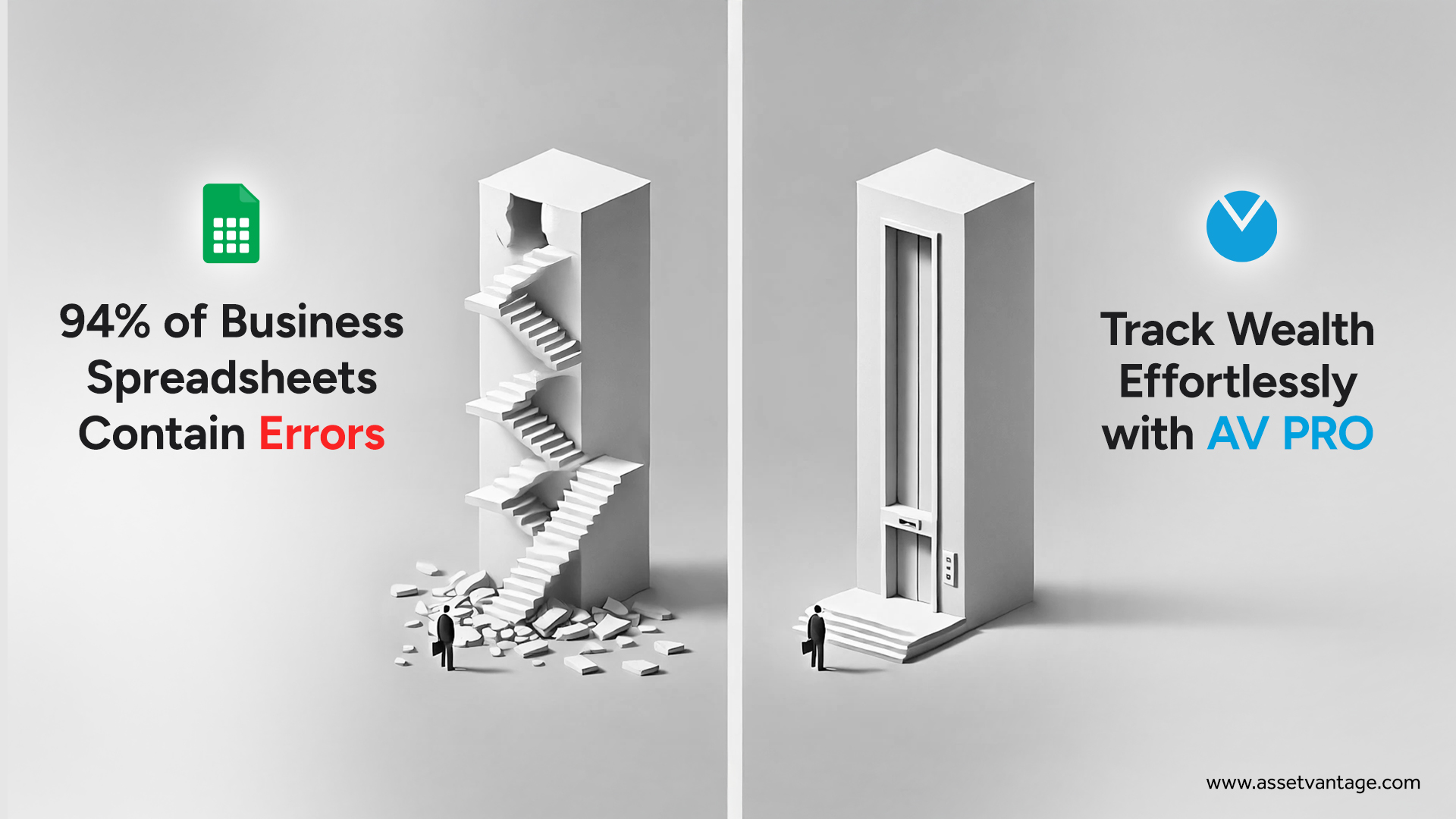
In an era where on-demand financial insights are the building blocks of smart investment decisions, relying on spreadsheets means hours of manual work, an increased risk of errors, and missed opportunities. A study published in Frontiers of Computer Science found that 94% of business spreadsheets contain errors—a risk no family office can afford when overseeing significant assets.
It’s time to break free from static spreadsheets and embrace a future-ready solution that delivers real-time intelligence, automation, and control. Let’s explore why spreadsheets no longer serve the needs of modern family offices— and why a specialized accounting software for family offices is now essential.
Generic Spreadsheets: Stumbling Blocks in Today’s Wealth-Tech Industry
Spreadsheets work best when the goal is simply to record a limited number of financial transactions and apply basic formulas for quick insights. However, running analysis for optimal decision making across multi-entity structures, diverse asset classes, and offshore holdings—demands far more than pre-set formulas and rudimentary data analysis. With family offices collectively overseeing approximately $3.1 trillion in assets, according to Deloitte’s 2024 report, they require specialized software that automates data aggregation and reconciliation. More importantly, they need a system that transforms raw data into structured intelligence, rather than just displaying numbers. Without these capabilities—where spreadsheets fall short—family offices lack a clear, current view of their wealth, limiting their ability to optimize portfolio performance and maximize returns.
Here are the biggest drawbacks of relying on spreadsheets for family office wealth management:
- Manual Data Entry Limits Productivity: Every transaction, valuation update, and reconciliation requires manual input. Time that should be spent on portfolio oversight and decision-making is instead lost to routine data management.
- No Safeguards Against Errors: A formula override or incorrect copy-paste can alter calculations without detection. With no automated checks, errors can persist unnoticed, affecting financial reporting and decision-making.
- Lacks Real-Time Market Integration: Market prices, corporate actions, and capital calls must be manually updated. By the time adjustments are made, financial data is already outdated, limiting the ability to act on timely opportunities.
- Struggles to Scale with Complexity: As your wealth grows, so does your spreadsheet. Giant workbooks with countless tabs and rows become slow and crash-prone. It simply isn’t built for the scale or complexity of a multi-entity (trusts, SPVs, holding companies), multi-asset (both liquid and illiquid) portfolio.
- Fragmented Data, No Single Source of Truth: Managing equities, private investments, real estate, and alternative assets across multiple spreadsheets results in data disconnects. Without a unified view, reconciling holdings, liabilities, and cash flows requires constant back-and-forth between files.
- Poor Data Security:Spreadsheets offer no way to set user permissions or keep an audit trail of changes leading to greater likelihood of data breaches.
- Limited Analytical Insight: While spreadsheets capture raw data, they lack built-in portfolio performance tracking, risk assessment, and liquidity analysis. Advanced analytics require complex formulas and continuous manual updates, making it difficult to generate real-time, actionable insights.
Asset Vantage: Purpose-Built Investment Accounting Software for Family Offices
Asset Vantage (AV) is a SaaS-based investment accounting and reporting software for family offices, purpose-built to streamline asset management, transparency and the family’s financial legacy. It provides automated financial data aggregation across all asset classes (both liquid and illiquid), an integrated general ledger that simplifies reporting for both investment portfolios and books of accounts, and comprehensive portfolio reporting across multiple asset types, currencies, advisors, and geographies. By consolidating wealth data into a single, intelligent platform, AV eliminates manual inefficiencies and ensures accuracy, transparency, and control. As a specialized integrated investment accounting software, AV overcomes the limitations of relying on data sitting within spreadsheets and a standalone accounting tool. With AV family offices are empowered with mission critical insights on the go for confident decision-making.
1.Automated Data Aggregation
AV streamlines financial tracking by seamlessly onboarding data from multiple sources, such as banks, custodians, and advisor statements, ensuring real-time reconciliation. Unlike spreadsheets, which rely on manual data entry and verification, AV’s automated data aggregation eliminates human errors, speeds up processes, and ensures data accuracy across all financial records.
2.Comprehensive Wealth View
AV provides a single source of truth by integrating holdings across asset classes, geographies, currencies, entities, sectors, and financial advisors into one unified dashboard. This enables users to track portfolio performance instantly without the need for manual updates and file sharing, which is a common limitation of spreadsheets. By offering live visibility into investment positions, cash flows, and risk metrics (such as TWR and IRR), AV ensures decision-makers have access to the entire net worth when they need it.
3. Integrated Accounting & Reporting
Unlike generic spreadsheets or accounting tools, where financial data remains fragmented and requires manual reconciliation, AV’s integrated general ledger ensures seamless tracking of all transactions. Every trade, dividend, and expense is automatically recorded across both the investment portfolio and book of accounts, ensuring seamless reconciliation and audit-ready financials. With detailed trial balances, multi-period income statements, auto-ledger entries for investment accounting, and partner look-through for multi-level partnership accounting, AV eliminates duplication and delivers a unified, real-time view of financial data—allowing family offices to manage wealth with precision and efficiency.
4. Built-In Advanced Analytics
AV eliminates the need for users to manually compile performance data through complex pivot tables or formula-driven spreadsheets. It provides granular analysis of asset classes, investment strategies, and advisor performance through customizable performance reports, multi-period performance tracking with TWR and benchmark comparisons (MTD, QTD, FYTD, 1Y, 3Y, 5Y, etc.), and IRR-based evaluation for illiquid assets. With built-in tools to assess risk-adjusted returns, track portfolio allocation across currencies and geographies, and generate entity-level insights, AV delivers the real-time intelligence family offices need to optimize their investment strategies.
5. Collaboration & Accessibility
AV removes the inefficiencies of spreadsheet-based financial management by enabling multiple users to work simultaneously on a single, unified platform. Unlike generic spreadsheets, where files must be manually shared and updated, AV provides real-time collaboration for family principals, accountants, investment analysts, and external advisors. With a private cloud-based system, users can access financial data from anywhere, at any time, ensuring that decision-makers always have the latest insights without delays. No more version conflicts, outdated files, or waiting for reports—just seamless collaboration and instant access to critical financial information.
6. Robust Security & Privacy
While spreadsheets are prone to unauthorized access, accidental modifications, and data breaches, a secure accounting software for family offices such as AV is built with enterprise-grade security features that safeguard financial data. A single-tenant database ensures that you own your data, while SOC 2-certified encryption protects financial records both in-transit and at-rest. Additionally, role-based access controls allow each user—whether an accountant, investment analyst, family principal, or external advisor—to access only the information relevant to their role, preventing unauthorized viewing or editing of sensitive financial data. Detailed audit trails further enhance security by tracking every user session, recording who accessed what, when, and from where, ensuring complete transparency and preventing unauthorized changes. These comprehensive security measures make AV a far more secure and reliable alternative to generic spreadsheets.
Conclusion
Spreadsheets may have been a reliable tool in the past, but modern family office management demands more. Handling complex portfolios across multiple asset classes, entities, and currencies requires an investment accounting software for family offices that delivers automation, real-time insights, and airtight security.
This is why 350+ global families across 10+ countries trust Asset Vantage to manage their data and reporting of over $400 billion in assets, leveraging its integrated general ledger, custom performance reporting, and automated data aggregation to maintain accurate financial records and make informed decisions with ease.
Stop relying on outdated spreadsheets. Request a demo today to learn how an accounting and reporting software for family offices like Asset Vantage can help you take control of your financial data and legacy.