
How a Chicago-based Accounting Firm Replaced Spreadsheets with an Integrated Family Office Platform to Achieve Scale, Efficiency, and Client Trust
A leading Chicago-based accounting firm had built a strong reputation serving HNW and UHNW families.
Asset Vantage Systems Private Limited : Email: info@assetvantage
We’ll equip you to become the accountant you’ve always wanted to be:
A “Wealth Custodian” trusted, and even cherished, by UHNW families

Get a comprehensive view of the total family net-worth with powerful entity consolidation and partnership look-through.

The AV family office platform is a single point of book-keeping built on global IFRS and GAAP standards ensuring seamless integration of the GL with the investment book.

Our partnership accounting feature provides clients with the ability to account for and manage their family investment partnerships, whether at the partner or partnership level.

AV delivers ‘Accountant-Ready’ tax reports, saving time by providing easy, consolidated reporting for individuals and family limited partnership entities such as LLCs, trusts and more.
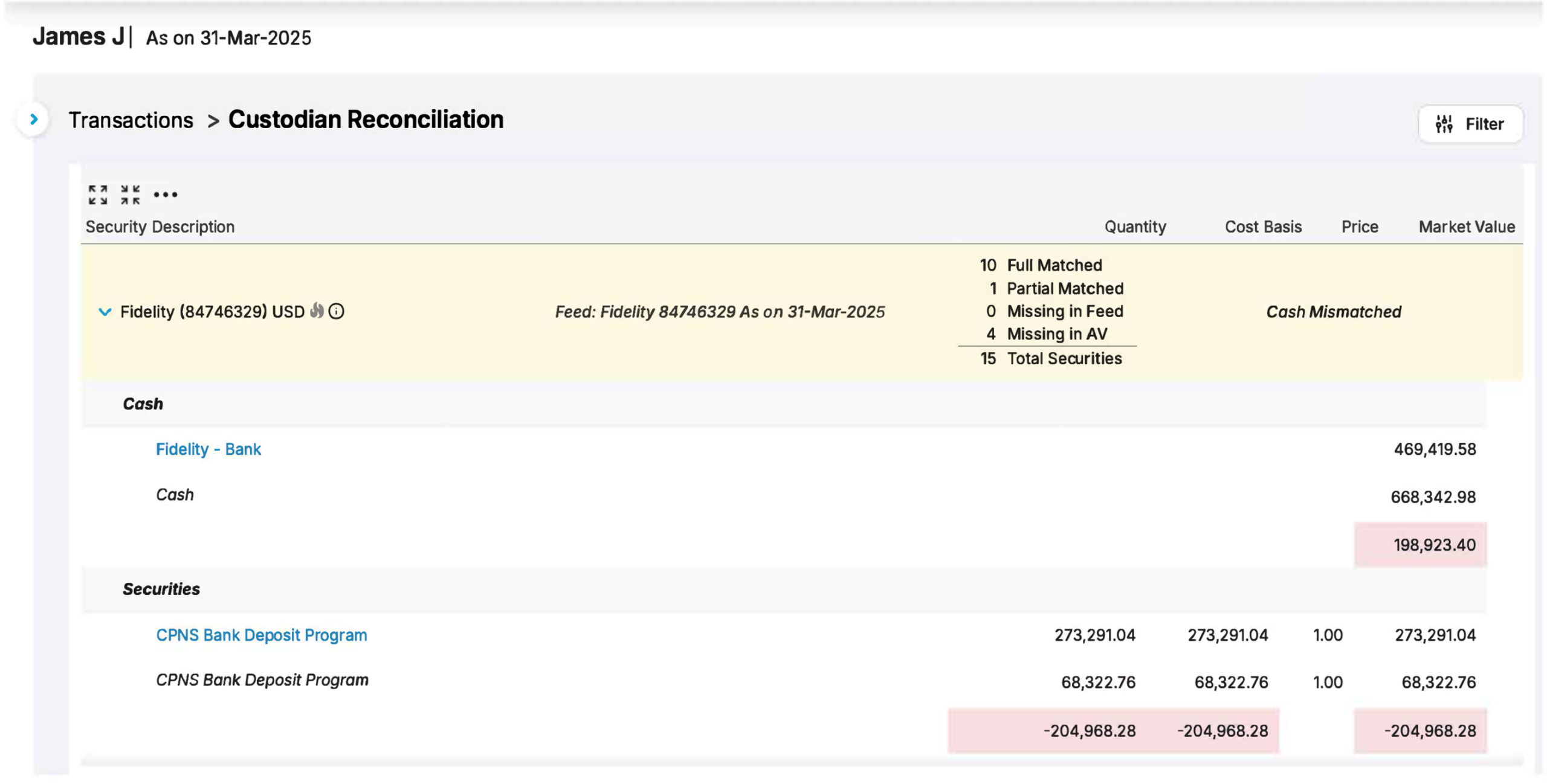
Upload and sync investment transactions for simple and accurate data aggregation across entities, advisors, banks and custodians.

AV’s Document Vault feature allows you to securely upload, tag and save important documents to any specific transaction, investment holding or entity. Now digitize all your physical investment documents, easily store them in one place and retrieve them on-the-go.

Asset Vantage is purpose-built for CPA firms serving high-net-worth (HNW), ultra-high-net-worth (UHNW), and family office clients with $20M+ in investable assets. The platform is designed for clients with complex, multi-entity structures, LLCs, trusts, foundations, retirement vehicles, and individual accounts and multi-asset class portfolios that include marketable securities, private equity, hedge funds, real estate, and collectibles.
Most accounting and portfolio tools are designed for single-entity, liquid-asset clients. Asset Vantage unifies accounting (ABOR), investment reporting (IBOR), bill pay, consolidated reporting, and tax planning data in a single platform, purpose-built for the complexity of multi-entity, multi-asset class HNW clients. The result: CPA firms can deliver family office-level service without building a family office.
The platform ingests bank feeds (via Morningstar, Plaid), custodian transaction feeds for over 100 custodians from direct or various transaction and tax lot level feed providers for (eg: Pershing, Fidelity, Schwab, TD Ameritrade, Northern Trust, JPM and many more), and market data for daily EOD pricing, automatically. Reconciliation is continuous and exception-based: staff review flagged anomalies rather than building reconciliations from scratch. This eliminates 80%+ of manual data entry and recaptures 10–18 staff hours per client per month.
Cash uses direct bank feeds. Marketable securities are ingested via Refinitiv, allowing daily EOD market data, the system maintains tax-lot data and reconciles shares, cash, and pricing to the custodian. For alternative assets (private equity, hedge funds, real estate), Asset Vantage integrates via Arch API or handles data through manual bulk upload or managed services, depending on the fund’s reporting infrastructure.
Yes. The system ingests transactions from the custodian and uses a Refinitiv / LSEG market data feed for daily pricing.
Tax-lot level data is maintained, and shares, cash, and pricing are reconciled to custodian records. For stocks, bonds, and ETFs, pricing typically ties out precisely. Exceptions are surfaced automatically for review.
Asset Vantage supports two primary methods: (1) Dynamic NAV-based ownership- updated based on net contributions adjusted for NAV at the time of contribution; or (2) Static percentage ownership- stored by date to reflect historical allocations.
Partnerships and Investing companies are typically represented through contributions and distributions with NAVs.
Trusts are typically represented by static percentage beneficial ownership.
The platform can represent ownership as unitized (unlisted securities) or by book capital percentages, and can create quantities and prices to produce share-like representations for each beneficial owner.
NAVs are derived from a combination approach: the system records debits and credits for transactions and computes unrealized gain/loss by comparing prior and current values while backing out period cost changes. This hybrid ABOR/IBOR methodology ensures that both the accounting book of record and investment book of record reflect accurate, current valuations for each entity and beneficial owner.
Yes. By pivoting to a holdings view, Asset Vantage consolidates positions across all accounts and partnerships to show total exposure by holding or by beneficial owner. This is particularly powerful for UHNW clients with layered entity structures, a CPA can instantly see a family member’s aggregate economic exposure to any single investment across all vehicles.
Yes. Best practice is to create and track each side pocket individually within Asset Vantage. The system can then consolidate them into an aggregate entity view, showing partner splits and eliminations in a consolidated balance sheet report. This provides both granular sleeve-level visibility and clean consolidated reporting for the overall partnership.
Waterfall and carried interest fee calculations are not performed natively within Asset Vantage. For these calculations, third-party tools (such as Qashqade) are recommended to perform the waterfall and fee computations, with the resulting allocations fed back into the Asset Vantage platform for consolidated reporting and accounting. This preserves the flexibility to use specialized fund administration tools while maintaining a unified book of record.
The platform provides a real-time unrealized gain/loss dashboard by tax-lot, security, account, and entity, enabling CPA firms to identify tax-loss harvesting opportunities, monitor capital gain exposure, and coordinate charitable giving throughout the year. Year-to-date income is tracked by type (ordinary income, qualified dividends, capital gains, K-1 income). Cash flow projection tools support estimated tax payment planning. Automated alerts notify CPAs of significant gain/loss events and capital call cash needs.
Asset Vantage supports tax-basis adjustments for holdings (stocks, private equity, managed accounts, partnerships and more). K-1 tax-basis adjustments require manual entry of transactions or journal entries to reflect the adjusted tax basis at the holding level. These entries can be mapped into a tax-focused chart of accounts for tie-out to tax return
schedules, supporting Schedule K-1 preparation and partnership tax filings.
Asset Vantage is pursuing integration with K1X for automated K-1 data ingestion, which would enable digitized K-1 data, including non-trial-balance tax items, to flow directly into accounting workflows. This integration is in active development through the Asset Vantage app store partner program. In the interim, K-1 data can be entered via manual upload or journal entries.
The platform’s full-balance-sheet visibility, including alternative assets via 3rd party Alternate Asset Aggregators such as Arch, (Canoe Intelligence, AltExchange can be added on-demand) through API integrations, gives CPAs real-time data on the illiquid portion of portfolios where the highest tax leverage often exists: QSBS exclusions, opportunity zone elections, and carried interest treatment. CPAs can proactively model and plan for these items rather than reacting at year-end.
Asset Vantage includes a cash flow projection model that supports forecasting of cash events, interest payouts and fixed income maturity, capital calls, distributions, estimated tax payments, and operating expenses, across all entities.
The cash flow model enables CPAs to project liquidity needs and coordinate funding across complex multi-entity structures well in advance.
APIs to this cash flow model can be exposed to third party what-if analysis solutions.
Yes. The platform maintains a real-time unrealized gain/loss dashboard at the security, account, and entity level, updated via daily market data feeds for marketable securities and periodic marks for alternative assets. CPAs can view aggregate unrealized exposure across all entities for a single client, enabling tax-loss harvesting decisions, gain recognition timing, and year-end planning without waiting for year-end data.
Broad what-if scenario analysis is not currently a native feature of Asset Vantage. However, the cash flow projection model allows CPAs to model forecasted cash events and evaluate their timing, for example, modeling the liquidity impact of a planned capital call, a large charitable gift, or a tax installment payment. For deeper scenario modeling, CPAs can export data to Excel for custom analysis.
ABOR (Accounting Book of Record) tracks financial transactions, journal entries, cash movements, and tax-basis accounting, the data CPAs need for tax preparation and entity-level financial statements. IBOR (Investment Book of Record) tracks portfolio positions, market values, performance, and unrealized gains/losses, the data wealth managers and investment advisors need. Asset Vantage is one of the few platforms that unifies both, giving CPA firms access to both dimensions for each client and entity without requiring a separate portfolio management system.
Asset Vantage supports multiple export formats: dashboards can be shared with specific users electronically, exported as a static PDF snapshot, or individual widgets exported to Excel for further manipulation. Client-ready PDF reports can be generated on demand or delivered on a scheduled basis, and all reports can be white-labeled in the CPA firm’s branding.
The system supports a standard library of 100+ benchmarks which can be assigned per-holding or per-aggregate or overall portfolio levels for liquid and alternative or private holdings.
Support for direct user uploadable custom or client-specific blended benchmarks coming soon.
Asset Vantage auto-generates consolidated net worth statements, performance reports, and cash flow summaries across all accounts and entities, including alternatives, in real time. Reports include time-weighted and money-weighted return calculations, entity-level drill-downs, and cross-entity cash flow views. The CPA firm becomes the single source of financial truth, with reports that rival multi-family office quality.
Asset Vantage enables bill pay capabilities through integration with best-in-class third-party solutions such as Bill.com which orchestrate approval work-flows, track payment status and actually make the payments.
These transactions automatically sync to the AV system once the bills are processed and paid for seamless booking.
Using best-in-class solutions help reduce E&O exposure while increasing productivity with automatic posting to AV’s integrated general ledger. This enables CPA firms to offer bill pay as a coordinated, fee-based managed service with integrated UHNW investment reporting without building such integrations from scratch.
Asset Vantage maintains a complete, timestamped, user-attributed, and immutable audit trail for every transaction, approval, and data change. Records cannot be deleted without an audit log entry.
Documents stored with transactions and holdings, such as K-1s, capital call notices, and wire confirmations, expense recipts, trust documents, real estate and rental agreements attached to corresponding entries, are exportable for IRS audit response, estate administration, or professional liability review. This eliminates weeks of documentation assembly when audit or estate events occur.
MFOs compete on holistic financial management- investment, tax, estate, bill pay, and reporting under one roof.
Asset Vantage gives CPA firms MFO-level capabilities at a fraction of the cost of building or staffing a full family office.
Once a client’s financial data is consolidated and reporting is live on the platform, switching costs are high. CPA firms using Asset Vantage report materially higher client retention in their HNW segment.
Wealth managers are expanding into reporting, cash flow management, bill pay, and financial planning, traditionally CPA territory. Asset Vantage enables CPA firms to offer the full suite of family office services (consolidated reporting, bill pay, cash flow advisory, investment monitoring) without hiring additional staff.
A CPA firm managing 20 HNW clients at $20M+ each can not only increase stickiness to clients but also realistically boost revenue through a full suite of services with recurring advisory revenues.
CPA firms using AV have been able to bring efficiency as well as increase in client in-take.