
Read Time4 Mins
Family offices are evolving. Their investments are spread across countries and various liquid and illiquid asset types, further held through intricate legal structures, making the family office of the 21st century as complex as an institutional investor. What’s more, family office principals are also becoming more financially savvy, and bring the same rigour to their wealth management as their business. Financial advisors and portfolio managers of family offices hence have their work cut out for them to deliver a comprehensive view for decision making. The benefits of portfolio accounting software transforms how financial advisors manage and analyze family office portfolios.
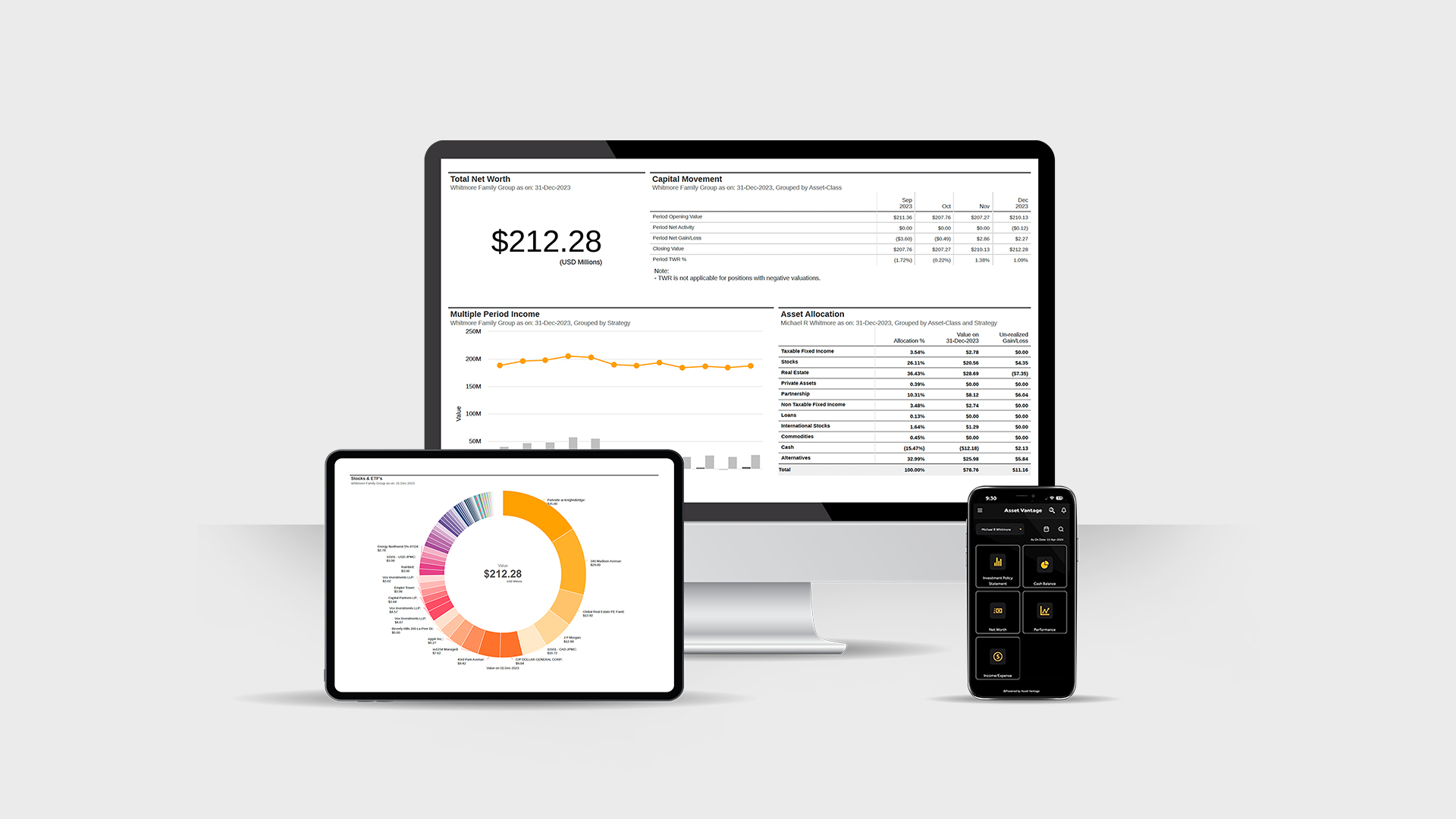
Fortunately, modern technology such as Asset Vantage comes through to transform the way portfolio managers can service their clients. Integrated general ledger and reporting software cut through the complexity to seamlessly aggregate and consolidate investment data onto a single platform to present the full picture of a family office’s assets. This is achieved through powerful automation, releasing staff from time-consuming and error-prone manual effort and providing them with the latest information in real time. Highly-configurable analytics capability then presents unique actionable insights to maximize returns.
With the cloud-enabled Family Office 4.0 revolution making such platforms available at a fraction of the cost, these tools are the greatest investment with long-term benefits that a portfolio manager can make. Greater time to focus on strategy rather operational tasks unlocks game-changing value for family offices and their advisors.
Benefits of Using the Right Portfolio Accounting Software
The right portfolio accounting software brings numerous benefits, transforming how financial advisors manage and analyze family office portfolios:
Improved Efficiency and Productivity: Information pulled automatically from custodian and bank feeds onto the platform saves the time of manual effort and removes the risk of human error. As the single source of truth, the platform facilitates efficient workflow and collaboration among team members, and frees up time to focus more on strategy for family office wealth generation.
Integrated Accounting and Customizable Reporting: An integrated portfolio accounting software offers multiple tools for compiling and evaluating investment portfolio performance reports, underpinned by accurate and comprehensive book-keeping. It can then generate input reports to help meet statutory or regulatory requirements such as tax returns or compliance filings, and also highly customized analytics that meet every user’s individual needs. Automated benchmarking over multiple periods for diverse asset types provides new ways of analyzing the portfolio.
Security and Confidentiality: For wealthy families, data protection is particularly crucial. The right software deploys the latest measures for data integrity in compliance with prevailing regulations, such as access control, encryption and daily back-ups. Portfolio managers thus ensure the trust of family offices and work together better.
Better Decision-Making: Portfolio accounting software equips family offices with real-time, accurate data and drill-down analytics. Armed with insights which take into consideration the full breadth of their portfolio, family offices can take significantly better decisions with ease and attain their financial goals.
Adopting effective Portfolio Accounting Software not only simplifies the management of diverse assets but also enhances the overall strategic capabilities of family offices, driving clarity in decision making.
Conclusion
The right portfolio accounting software brings crucial benefits for the successful investment management and operations of a family office. Asset Vantage stands out as a holistic solution that combines performance reporting and general ledger technology to provide a single source of truth for global and modern family offices. This integration improves processes, minimizes manual effort, and lowers costs by combining several systems onto a single platform. This increases productivity, gives better information, limits risks, and facilitates informed decision-making. With Asset Vantage, family offices can efficiently navigate today’s financial world and achieve wealth maximization.
[maxbutton id=”9″ ]


