
Read Time6 Mins
Many family offices still rely on fragmented legacy systems like spreadsheets, accounting software and portfolio tracking tools for investment accounting. While these systems may seem practical at first, they eventually lead to inefficiencies, errors, and time-consuming reconciliations.
Siloed data limits real-time insights, slowing decision-making and increasing risks related to performance, compliance, and generational wealth growth. To make matters worse, a report by Deloitte reveals that 34% of family offices are underinvested in technology needed to run them efficiently.
This blog explores the hidden costs of disparate systems and how centralizing operations through a unified software can streamline workflows, improve efficiency, and save valuable time.
Hidden Costs of Disparate Systems
There are a host of problems that family office principals, next-gen leaders, and professionals who serve them face because of business-critical data being stored on disparate systems, such as:
1. Fragmented wealth data
Problem: Family offices oversee diverse portfolios, including real estate, private equity, hedge funds, art collections, and more, which are often managed in siloed systems.
Impact: Without a unified view, it’s nearly impossible to assess the family’s total wealth and asset allocation to make long-term strategic decisions confidently.
Also Read: Solving the Data Dilemma: Challenges and Solutions for Family Offices
2. Manual data entry and reconciliation
Problem: Disconnected legacy systems force accounting executives to manually input and reconcile data across platforms.
Impact: This tedious process is error-prone, leading to inaccurate financial reports and potentially costly mistakes.
3. Sub-optimal portfolio performance
Problem: Slicing and dicing data backed by performance metrics remains a manual-heavy, resource-intensive process, constrained by over-reliance on spreadsheets and high people dependencies.
Impact: Decision makers fail to respond to updated insights, leading to misalignment in allocation plan, sub-optimal alpha and potentially high operational costs.
4. Cybersecurity threats
Problem: Multiple disconnected systems with inconsistent encryption, access controls, and authentication create security gaps, increasing the risk of unauthorized access, data breaches, and cyber threats.
Impact: Without a centralized security framework, sensitive data, including private investment details such as tax records, succession plans, and personal identity documents remains vulnerable to cyberattacks and fraud.
5. Compliance and reporting challenges
Problem: Regulatory requirements demand accurate, timely reporting, but disparate systems make data aggregation and compliance reporting a difficult process.
Impact: Family offices risk penalties, reputational damage, or legal issues due to incomplete or delayed compliance.
6. Scalability challenges
Problem: As families grow their wealth or add new asset classes, legacy systems struggle to keep up.
Impact: The lack of scalability forces family offices to adopt even more systems, increasing complexity and costs.
7. High operational costs
Problem: Maintaining multiple systems requires significant investment in software, IT support, and technical training for family office professionals.
Impact: These costs divert resources from strategic activities, such as investment management or inter-generational planning.
8. Resistance to innovation
Problem: Legacy systems often lack the flexibility to integrate with modern technologies like AI, ML, predictive analytics, or automated workflow tools.
Impact: Family offices risk falling behind, missing out on opportunities to enhance decision-making, optimize portfolios, or improve operational efficiency, which are increasingly expected by tech-savvy family members and stakeholders.
Must Read: 6 Must-Have Reports for Family Offices in a Financial Reporting Software
How Asset Vantage solves the challenge of disparate systems for family offices
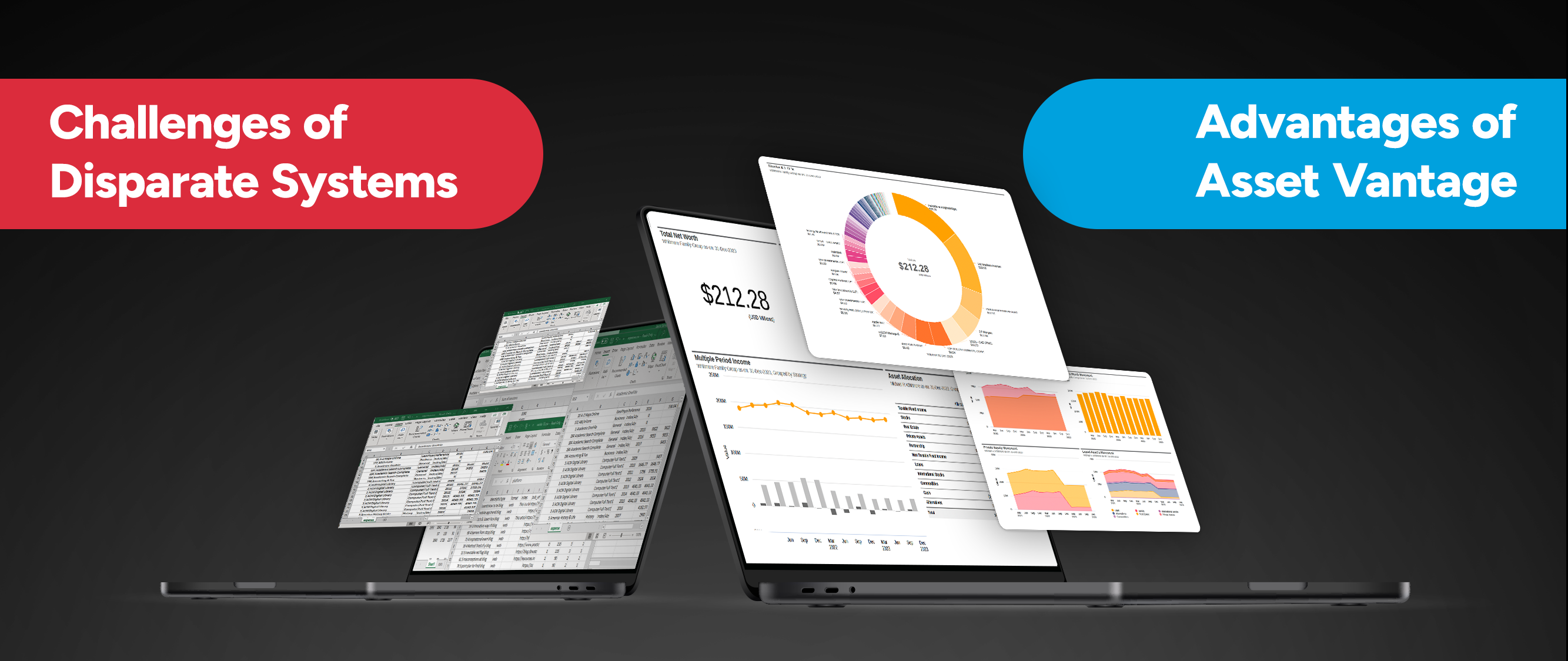
Asset Vantage is a cloud-based Family Office Software designed to streamline operations, enhance data accuracy, and provide a unified view of the family’s entire net worth, thereby eliminating the reliance on disparate systems. Here’s how it addresses the key pain points:
1. Automated data aggregation
Solution: The platform automates data collection from custodians, banks, and market feeds, drastically reducing manual intervention.
Benefit: This increases productivity and reduces errors, ensuring timely and accurate financial reporting.
2. Unified wealth tracking
Solution: Asset Vantage enables family offices to consolidate investments in liquid assets, business entities and personal assets (real estate, private equity, art collections) into a single platform.
Benefit: Family principals gain a holistic view of their net worth, enabling better decision-making and strategic planning.
3. Advanced performance analytics
Solution: Asset Vantage is a feature-rich platform offering deep insights through comprehensive data analysis across individual and group entities. With on-demand access, users can evaluate portfolio performance at a granular level across all asset classes, investment strategies, advisor performance, and more.
Benefit: Family offices can leverage data insights to optimize portfolios and identify growth opportunities.
4. Integrated general ledger
Solution: The general ledger automatically syncs journal entries from investment transactions, bank transactions, and other financial activities, ensuring seamless accounting without duplication.
Benefit: Family offices can track cash flows, inter-entity transactions, and capital allocations with precision, ensuring transparency and compliance while reducing reconciliation efforts.
5. Access all your documents in one place
Solution: AV’s Document Vault feature allows users to securely upload, tag, and save important documents associated with specific transactions, investment holdings, or entities.
Benefit: By centralizing document management, family offices can reduce their reliance on disparate systems, ensuring all critical information is accessible in one secure location.
6. Enhanced cybersecurity
Solution: AV sets a security benchmark with SOC 2 certification, ensuring robust data protection. Its comprehensive audit trail tracks user activity, detecting unauthorized access or suspicious behavior. Also, Vulnerability Assessment and Penetration Testing (VAPT) proactively identifies and mitigates risks.
Benefit: Family offices can safeguard sensitive data and prevent cyber threats, protecting their wealth against security risks.
7. Multi-currency and global support
Solution: Asset Vantage supports multi-currency reporting for globally held assets, with real-time exchange rate updates.
Benefit: Family offices with international portfolios can manage wealth seamlessly across geographies.
8. Simplified compliance
Solution: Asset Vantage generates IFRS and GAAP-ready reports, ensuring compliance with international accounting standards.
Benefit: Family offices can meet regulatory requirements without the hassle of manual data management and reduce the risk of errors or penalties.
9. Scalability for growth
Solution: The platform is designed to scale with the family office’s needs, whether adding new asset classes or expanding the number of entities per license as the family office expands its team or engages external advisors.
Benefit: Family offices can adapt to growth without the headache of managing multiple systems.
10. White-glove service
Solution: AV’s white-glove service ensures a smooth and hassle-free experience for clients. The team assists with onboarding and data migration, helps generate Monthly Investment Summaries (MIS), and provides training for both new and existing users. They also work closely with clients to identify and resolve system issues and gather feedback to drive improvements and new feature development.
Benefit: Clients receive expert support for troubleshooting, training, and system optimization, allowing them to easily manage their financial data and reports.
11. On-the-go financial insights with the AV PRO mobile app
Solution:
The AV PRO mobile app provides family offices with real-time access to their complete wealth portfolio, offering customizable performance reports and actionable insights anytime, anywhere.
Benefit:
Family offices can instantly view their total net worth, analyze individual asset classes, and make informed decisions on-the-go. With built-in security features, sensitive financial data remains protected, ensuring full control and confidentiality over wealth information.
Conclusion
Relying on multiple systems creates inefficiencies, security risks, and delays in decision-making for family offices. Asset Vantage solves this by providing an integrated GL with performance reporting and a document vault with automated data aggregation and enhanced security. By replacing disparate systems, family offices gain better financial oversight, ensure smoother succession planning, and operate with greater efficiency.
Are you struggling with multiple, disconnected tools to manage your financial data? Sign up for a sandbox demo to learn how Asset Vantage can unify your data into a single, seamless system.


