Asset Vantage

Returns from Investments are Notional Until Realized, but Cash is Real

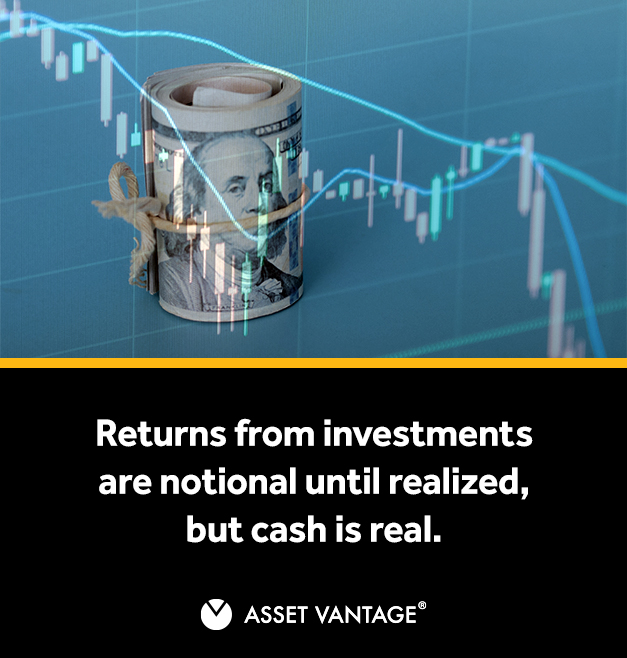
Rolled U.S. dollar bills in front of a fluctuating financial graph, symbolizing the concept that investment returns remain theoretical until realized, emphasizing the tangible value of real cash flow.

Read Time3 MinsCash is the lifeblood of a business and the ‘asset’ we fall back on in times of financial difficulty. Much like a round of chess, it is cash, the king, that keeps the game going. Every move impacts the endgame, smart investments are about strategic decisions that maximize your returns from investments—each choice […]

Read Time4 Mins

Cash is the lifeblood of a business and the ‘asset’ we fall back on in times of financial difficulty. Much like a round of chess, it is cash, the king, that keeps the game going. Every move impacts the endgame, smart investments are about strategic decisions that maximize your returns from investments—each choice bringing you closer to winning the financial game.

However, the most powerful player in chess is the queen. The game is significantly weakened without her considerable might. Communication is that piece of the chessboard. 

In a family office, the deployment of effective communication practices is two-fold: 

  • Between the principals and their families 
  • Between the family office professionals and family members


Between the principals and their families
 

Each generation has its own personality, objectives and risk appetite. Lamenting over ideological differences prevents the members from taking decisive actions. Just like we freely discuss if pasta sauce tastes better when it’s chunky or smooth, financial conversations too should flow with the same ease. 

Sure, money talk is not that casual. But there is scope to resolve or accept alternative views and arrive at a consensus. 

There is also an assumption that financial literacy is learned by simply coming from a place of wealth. If that were the case, the Chinese expression “Fu bu go san dai,” or “wealth never survives three generations” and the American version of this saying: “From shirtsleeves to shirtsleeves in three generations,” would not have had so many endorsers. 

It is one thing to have wealth today and another thing to hold it over generations A clear framework and conscious communication flow of financial matters, often aided by Family Office Software, are imperative to sustain wealth. 

We underestimate how emotional money is. Therefore, families must normalise conversation over wealth and create a non-judgmental environment for every member to speak up. 

Between the family office professionals and family members 

As outsiders, family office professionals have the advantage of objectivity. This makes them better suited to advise families on matters of personal wealth. However, the lack of a formal investment framework and financial instruction of the family members can obstruct effective communication of the advice. 

As a financial professional, you should take it upon yourself to institute a wealth framework in collaboration with the family. A framework such as an Investment Policy Statement defines the investment goals of a family and becomes a guideline for any financial conversations between members and advisors. Using Family Office Software can streamline this communication and ensure that all relevant information is accessible to both. 

Professionals need to be able to tailor their communication and ground it in a framework to make family members comfortable sharing their financial objectives. 

Develop a clear communication plan. Initiate periodic meetings with the family members to review their investment position. Stay up-to-date with their evolving goals so you can rebalance the portfolio suitably and in time. 

Go beyond being an advisor and enforcer of decisions. 

Optimize your portfolio and enhance returns on investments with our comprehensive family office software, tailored for high-net-worth individuals and family offices.

Bringing it together 

Communication, akin to the queen in chess, boosts the security of your family’s wealth across generations. All the stakeholders – family principals, members, and advisors – need to talk regularly and within a framework agreed with the family office and the family principals. Maximize returns on investments with our advanced family asset management software, providing transparency, control, and strategic insights for managing wealth effectively. Incorporating Family Office Software into these practices will help lay the foundation for a strong long-term strategy, be it chess or multi-generational wealth. 

Leave a Reply

Your email address will not be published. Required fields are marked *

Private Equity vs Hedge Funds

The Private Equity vs Hedge Funds Gap Is Narrowing Faster Than Most Investors Think

What Hedge Funds, Private Equity, And Family Offices Actually Are Hedge funds, private equity, and family offices sit within the same alternative investments universe but pursue different investment objectives. A…
Asset Swap Accounting

Asset Swap: What It Is and Why It Gets Confused With CDS

What is an asset swap? An asset swap is a fixed-income package that combines a bond with an interest rate swap to turn the bond’s fixed cash flows into floating-rate…
Concentration Ratio

Concentration Ratio: Formula, Meaning, and Why Regulators Care

What is a concentration ratio? A concentration ratio measures how much of a market is controlled by the largest firms by adding their combined market shares, commonly with CR4 or…
Family Fund

Family Fund: What It Is and Which Type Fits You

Which family fund type fits you? The right family fund depends first on purpose: use a private foundation or donor-advised fund for charitable giving, and a shared investment or savings…
Tax Lot Method

Tax Lot Method: What It Is and Why It Changes Your Tax Bill

Taxes follow the sequence of actions, not just the size of gains. For tax purposes, the order in which investors sell shares determines how the Internal Revenue Service classifies every…
Discretionary vs non-discretionary accounts

Discretionary vs Non-Discretionary Accounts, Clearly Defined

What a Discretionary Account and a Non-Discretionary Account Actually Let an Advisor Do The key question is who controls trade execution within the brokerage account. In a discretionary account, the…
Private Equity vs Hedge Funds

The Private Equity vs Hedge Funds Gap Is Narrowing Faster Than Most Investors Think

What Hedge Funds, Private Equity, And Family Offices Actually Are Hedge funds, private equity, and family offices sit within the same alternative investments universe but pursue different investment objectives. A…
Asset Swap Accounting

Asset Swap: What It Is and Why It Gets Confused With CDS

What is an asset swap? An asset swap is a fixed-income package that combines a bond with an interest rate swap to turn the bond’s fixed cash flows into floating-rate…
Concentration Ratio

Concentration Ratio: Formula, Meaning, and Why Regulators Care

What is a concentration ratio? A concentration ratio measures how much of a market is controlled by the largest firms by adding their combined market shares, commonly with CR4 or…
Family Fund

Family Fund: What It Is and Which Type Fits You

Which family fund type fits you? The right family fund depends first on purpose: use a private foundation or donor-advised fund for charitable giving, and a shared investment or savings…
Tax Lot Method

Tax Lot Method: What It Is and Why It Changes Your Tax Bill

Taxes follow the sequence of actions, not just the size of gains. For tax purposes, the order in which investors sell shares determines how the Internal Revenue Service classifies every…
Discretionary vs non-discretionary accounts

Discretionary vs Non-Discretionary Accounts, Clearly Defined

What a Discretionary Account and a Non-Discretionary Account Actually Let an Advisor Do The key question is who controls trade execution within the brokerage account. In a discretionary account, the…