Asset Vantage

Data Security & Privacy in Family Office Software: What You Need to Know

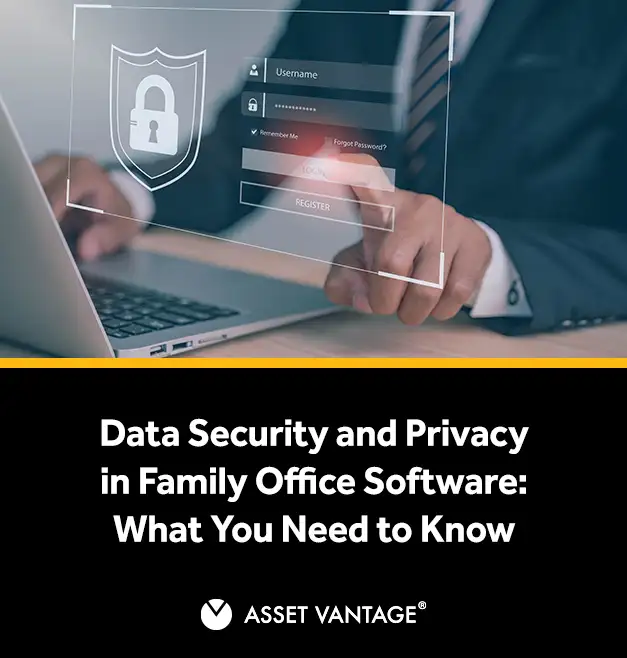
Business professional using laptop with digital security login screen, emphasizing data security and privacy in Family Office Software by Asset Vantage for protecting sensitive financial information.

Read Time2 MinsFamily offices are at the forefront of managing high-net-worth individuals’ assets, expertly navigating the complexity of their investments, estate planning, and philanthropy. Theirs is a crucial role that involves handling and storing sensitive information. However, many family office continue to use traditional tools such as spreadsheets, exposing themselves to financial, reputational, data security […]

Read Time3 Mins

Family offices are at the forefront of managing high-net-worth individuals’ assets, expertly navigating the complexity of their investments, estate planning, and philanthropy. Theirs is a crucial role that involves handling and storing sensitive information. However, many family office continue to use traditional tools such as spreadsheets, exposing themselves to financial, reputational, data security breach and legal risks.

Spreadsheets are useful and flexible, but they fail to protect against unauthorized access, data breaches, and human errors. This makes them susceptible to security breaches, comprising a family office’s confidentiality and credibility. Furthermore, using spreadsheets to store information may not meet regulations for personal data protection, leading to potential legal repercussions.

Family Office Software implement the latest technology and best practices for family office data confidentiality. Industry-leading platforms such as Asset Vantage consist of the security following features:

1. Data Ownership: Full ownership of data remains with the client so they have control over their information at all times.


2. Advanced Security Protocol:
State-of-the-art security measures, including:

  • Encrypted databases and communication
  • Multi-factor authentication
  • VPN-only access options

3. Private and Secure Backups: Daily data back up onto a reputed and secure cloud service for retrieval in case of any issues with the primary data source.

Also Read: Why Dashboards Matter: Steering FO’s Success with Data Visualization


4. Customizable Access Control and Permissions:
Family office-designated administrators with access control so only authorized personnel can view and alter various kinds of data.


5. Audit Trails and Compliance:
Continuous audit trails which meet industry and legal standards.


6. Centralized vs. Decentralized Data Storage:
A private cloud environment for each family office, as opposed to a multi-tenant database, so the data of each platform user remains distinct from the rest.

With the increasing complexity of family office portfolios, harnessing technology is the only way to ensure optimal financial management. Once the data security and privacy of such modern tools is assured as well, families can focus solely on growing their wealth.

Leave a Reply

Your email address will not be published. Required fields are marked *

How Multi-Family Offices Can Scale Client Reporting Without Scaling Chaos

Reporting works when you have a few clients Reporting rarely feels broken in the early stages of a multi-family office. With a limited number of clients, the team understands each…

How CPA Firms Can Deliver More Value to Family Office Clients With Better Infrastructure

The role has already changed. The system has not The expectation from CPA firms serving family offices has already moved beyond accounting. Clients are not requesting that books be maintained.…

Why Fragmented Workflows Keep Family Offices Stuck in Spreadsheet Mode

The system looks complete until the work begins Most family offices operate with a full stack of systems. Accounting is in place. Portfolio reporting exists. Documents are stored and accessible.…

One Family, Many Entities: Why Modern Wealth Breaks Traditional Accounting Systems

Wealth is no longer held in one place Wealth used to sit inside a structure that could be understood in a single view. Today, that assumption no longer holds. What…

Why Family Offices Need Accounting and Performance Reporting in the Same System

The invisible gap most family offices operate with Most family offices believe they have a clear view of their financial position. They have accounting systems that track income, expenses, balances,…

Why Generic Accounting Software Fails the Modern Family Office

The assumption behind generic accounting systems Most accounting systems are not broken. They are working exactly as they were designed to. They were built for businesses that operate as a…

How Multi-Family Offices Can Scale Client Reporting Without Scaling Chaos

Reporting works when you have a few clients Reporting rarely feels broken in the early stages of a multi-family office. With a limited number of clients, the team understands each…

How CPA Firms Can Deliver More Value to Family Office Clients With Better Infrastructure

The role has already changed. The system has not The expectation from CPA firms serving family offices has already moved beyond accounting. Clients are not requesting that books be maintained.…

Why Fragmented Workflows Keep Family Offices Stuck in Spreadsheet Mode

The system looks complete until the work begins Most family offices operate with a full stack of systems. Accounting is in place. Portfolio reporting exists. Documents are stored and accessible.…

One Family, Many Entities: Why Modern Wealth Breaks Traditional Accounting Systems

Wealth is no longer held in one place Wealth used to sit inside a structure that could be understood in a single view. Today, that assumption no longer holds. What…

Why Family Offices Need Accounting and Performance Reporting in the Same System

The invisible gap most family offices operate with Most family offices believe they have a clear view of their financial position. They have accounting systems that track income, expenses, balances,…

Why Generic Accounting Software Fails the Modern Family Office

The assumption behind generic accounting systems Most accounting systems are not broken. They are working exactly as they were designed to. They were built for businesses that operate as a…