
Asset Vantage

Why Next-Gen Heirs Need More Than Advisors—They Need Transparency & Access

Read Time2 MinsWealth transfer is about more than just the wealth itself . It’s about responsibility, values, and ensuring the next generation is prepared to lead.For decades, family offices relied on advisors to manage wealth behind closed doors. That model is fading fast. Next-gen leaders don’t want to be sidelined; they want real access and […]

Read Time2 Mins

Wealth transfer is about more than just the wealth itself . It’s about responsibility, values, and ensuring the next generation is prepared to lead.
For decades, family offices relied on advisors to manage wealth behind closed doors. That model is fading fast. Next-gen leaders don’t want to be sidelined; they want real access and a seat at the table. And with $84 trillion set to transfer across generations by 2045, transparency isn’t optional, it’s what makes succession work.

The Disconnect: Why Traditional Models Fall Short

The Deloitte Family Office Insights report found that 30% of heirs feel unprepared to manage family wealth—often because they’ve grown too reliant on advisors. Here’s why that matters:

  • They don’t get real experience. Top-line summaries won’t build financial acumen. Without direct access to data, heirs struggle to make high-stakes decisions.
  • They become dependent. When every move runs through an advisor, heirs don’t develop independent thinking. That slows decision-making and weakens strategy.
  • Older generations hold back access. Families worry that too much transparency leads to entitlement. But in reality, a lack of transparency leads to disengagement.

If heirs aren’t financially confident, succession plans collapse. The fix? Bring them in early and make transparency the foundation of wealth transfer.
Transparency: The Key to Engaging Heirs

Most family offices believe their next generation is ready to lead. The reality? Many heirs have never had real visibility into how wealth is actually managed.

Transparency isn’t about dumping financial reports on the next-gen, it’s about active involvement. When heirs see real numbers and strategy in action, they ask better questions, build confidence, and contribute meaningfully.

Take the Lipitz Family Office (featured in Wealth Strategies Journal). By giving heirs real-time access to financial data and investment reports, they transformed passive beneficiaries into engaged decision-makers.

Leveraging Technology for Heir Engagement

Many family-offices struggle with granting financial access while maintaining governance. That’s where the right technology can significantly change the game.

Smart financial systems give next-gen heirs controlled access without compromising governance.

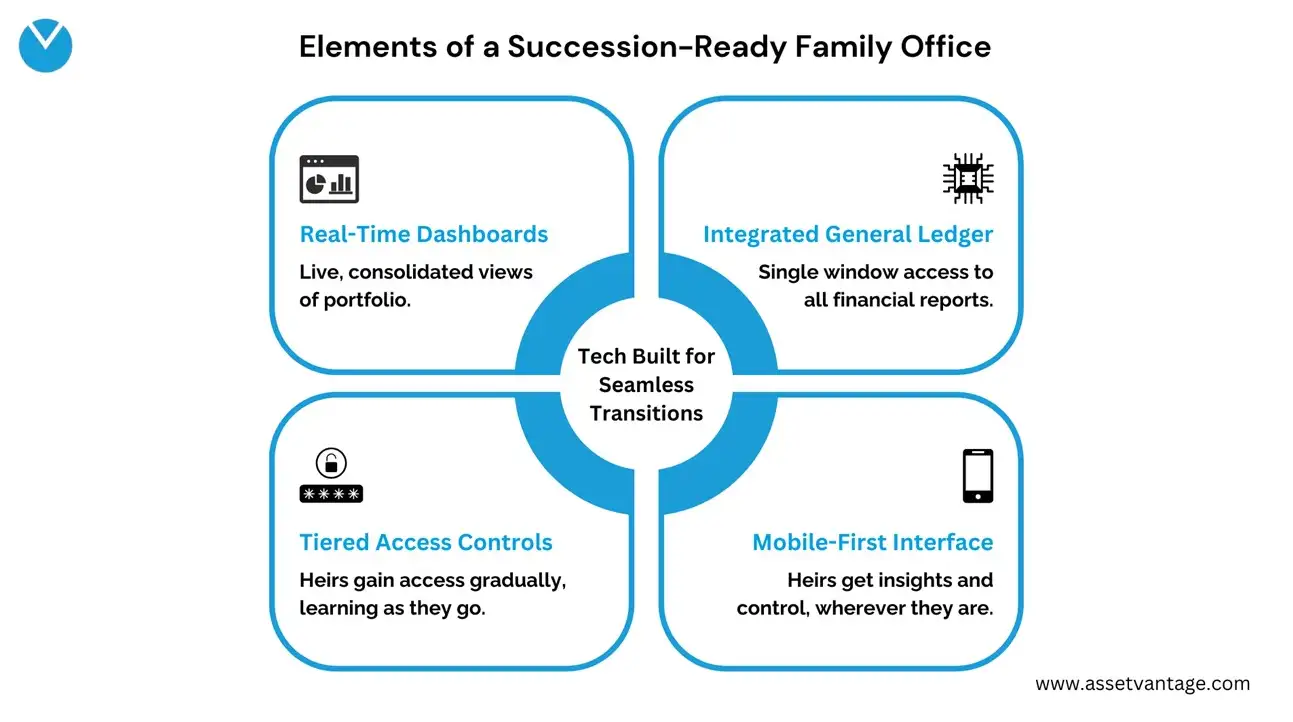
Here’s how Asset Vantage – a modern family office software enables smooth succession:

  • Real-Time Reports – Instead of scattered reports, heirs get a single source of truth, up-to date insights into investments, liquidity, and asset performance.
  • Custom Dashboards – Fully configurable dashboards allow the next-gen to setup a view of reports aligned to their preferences and priorities.
  • Integrated General Ledger -Gives heirs a clean, reliable financial foundation by automating complex accounting and simplifying insights on income and expenses.
  • Tiered Access Controls – Heirs start with portfolio overviews and gradually gain deeper financial access, ensuring they learn at the right pace.
  • Mobile-First Financial Management – Wealth isn’t just managed in boardrooms anymore. Mobile-first platforms let heirs stay informed and act when needed, from anywhere.

Securing Family Wealth for the Long Haul

By embracing transparency, families not only prepare heirs for the financial responsibility ahead but also fortify their legacy against the risks of disengagement, inefficiency, and outdated decision-making models.

With Asset Vantage, an integrated reporting and accounting solution,family offices are streamlining operations and creating a structured and transparent system that empowers heirs while maintaining governance and security.

Book a demo today  to find out how hundreds of global families are staying future ready.
Leave a Reply

Your email address will not be published. Required fields are marked *

real estate investment

Real Estate Investment Strategies that Build Resilient Passive Income

Why The Real Estate Industry Still Anchors Long-Term Income The real estate industry remains a core income engine because leases, rents, and asset values follow steadier patterns than public markets.…
portfolio vs benchmark

Portfolio vs Benchmark: Why This Comparison Matters to Investors

What does Portfolio vs Benchmark Actually Tell an Investor, and How Should it be Used? Portfolio vs benchmark is not a scorecard. It is a diagnostic tool that helps investors…
tax lot accounting

Why Tax Lot Accounting Shapes Returns More Than Most Investors Realize

Why Do Identical Investments Produce Different After-tax Returns? Because taxes are calculated at the tax lot level, not at the portfolio or security level. Even when two investors hold the…
private equity vs hedge funds

Private Equity vs Hedge Funds and the Rise of Crossover Allocations

What Hedge Funds, Private Equity, And Family Offices Actually Are Hedge funds, private equity, and family offices sit within the same alternative investments universe but pursue different investment objectives. A…
lower tax bill

Ways Professionals Lower Tax Bill Without Complicated Loopholes

How Professionals Actually Lower Tax Bill Over The Full Tax Year Professionals treat tax as a year-round discipline. They map income, deductions, credits, and timing into a single tax position,…
Consolidated portfolio

Why a Consolidated Portfolio Beats Scattered Investment Accounts

What Is An Investment Portfolio An investment portfolio brings together every choice you make about risk, time horizon, and cash flow across your financial situation. It includes each security, account,…
real estate investment

Real Estate Investment Strategies that Build Resilient Passive Income

Why The Real Estate Industry Still Anchors Long-Term Income The real estate industry remains a core income engine because leases, rents, and asset values follow steadier patterns than public markets.…
portfolio vs benchmark

Portfolio vs Benchmark: Why This Comparison Matters to Investors

What does Portfolio vs Benchmark Actually Tell an Investor, and How Should it be Used? Portfolio vs benchmark is not a scorecard. It is a diagnostic tool that helps investors…
tax lot accounting

Why Tax Lot Accounting Shapes Returns More Than Most Investors Realize

Why Do Identical Investments Produce Different After-tax Returns? Because taxes are calculated at the tax lot level, not at the portfolio or security level. Even when two investors hold the…
private equity vs hedge funds

Private Equity vs Hedge Funds and the Rise of Crossover Allocations

What Hedge Funds, Private Equity, And Family Offices Actually Are Hedge funds, private equity, and family offices sit within the same alternative investments universe but pursue different investment objectives. A…
lower tax bill

Ways Professionals Lower Tax Bill Without Complicated Loopholes

How Professionals Actually Lower Tax Bill Over The Full Tax Year Professionals treat tax as a year-round discipline. They map income, deductions, credits, and timing into a single tax position,…
Consolidated portfolio

Why a Consolidated Portfolio Beats Scattered Investment Accounts

What Is An Investment Portfolio An investment portfolio brings together every choice you make about risk, time horizon, and cash flow across your financial situation. It includes each security, account,…