
Read Time14 Mins
Which Version of Portfolio Monitoring Fits You
The first decision is not cadence. It is who carries the oversight responsibility, who receives the reporting, and how much monitoring burden sits behind each review. Portfolio monitoring changes shape when a PE team is tracking portfolio companies and fund updates, an advisor is monitoring many client accounts for drift, or an individual is reviewing a single portfolio without creating unnecessary work.
- Choose the PE or VC path if the portfolio supports company oversight, fund performance review, and LP reporting.
- Choose the advisor path if the job is to monitor multiple client portfolios, flag risk, and turn reviews into rebalancing or client action.
- Choose the individual investor path if a single portfolio needs a simple, consistent monitoring rhythm over time.
- Stop at the treasury note if the portfolio sits inside an enterprise cash, liquidity, or balance-sheet function rather than an investment oversight model.
PE or VC Firms: Monitoring Portfolio Companies, Fund Performance, and LP Reporting
Private equity and venture capital firms, including their teams, monitor three layers at once: portfolio companies, fund performance, and LP reporting. That creates a heavier monitoring burden than a simple portfolio review because the next action may sit at the company, fund, or investor-communication level.
Financial Advisors: Monitoring Client Portfolios for Drift, Risk, and Rebalancing
Advisors need a different operating model because the job is repeated across households, accounts, and review cycles. The core responsibility is to spot drift, risk changes, and rebalancing triggers early enough to support a client decision, not to watch performance in isolation. That makes the reporting audience broader and the escalation path clearer: a review has to lead to explanation, recommendation, or action.
Individual Investors: Monitoring a Portfolio Without Turning It Into a Second Job
For an individual investor, sustainability matters more than constant observation. The aim is to review investment portfolios often enough to catch meaningful change, while keeping the monitoring burden light enough that the process survives real life. If one person is managing a portfolio for personal decisions rather than reporting to clients or investors, this approach keeps attention focused without turning review into a second job.
Enterprise Treasury Teams: A Different Monitoring Job Than the Three Main Paths Here
Treasury monitoring serves corporate liquidity, cash positioning, and balance-sheet control, not the investment-oversight model used across the three paths here. When that is the job, the oversight responsibility, reporting audience, and decision path differ enough to require a treasury-specific framework. The common thread still matters: monitoring only counts when it changes a decision.
Portfolio Monitoring Is About Decisions, Not Just Checking Financial Performance
Monitoring becomes useful only when it changes what happens next. Across any portfolio, monitoring is not just a way to review financial performance or watch it drift over time. It is a decision-making system that turns signals into follow-up, escalation, or restraint so the portfolio can stay aligned with intended investment outcomes.
- Passive review records what the portfolio did.
- Active review ties information to data-driven decision making.
- The Real Test Is Simple: if nothing in the portfolio would change, the process is observation, not monitoring.
What Portfolio Monitoring Actually Covers Across Different Contexts
At its core, portfolio monitoring means watching for changes that warrant action, not simply updating records. The scope changes by audience, but the logic does not. In each context, portfolio monitoring involves assessing whether the portfolio is still behaving as intended, whether risk or performance has shifted, and whether portfolio management needs a response. The issue is not how much data a team collects. It is whether the portfolio is being reviewed in a way that supports action.
- For PE and VC firms, the focus can include portfolio companies, fund-level results, and reporting follow-up.
- For financial advisors, the focus is usually allocation drift, risk exposure, and client-level changes that need review.
- For Individual Investors, the Focus Is Narrower: a small set of portfolio checks that support consistent decisions without constant watching.
Passive Monitoring Tells You What Happened. Active Monitoring Changes What You Do Next
The distinction is operational. Passive monitoring is mostly performance measurement and status review. Active monitoring uses the same information to decide whether the next step should change.
| Dimension | Passive monitoring | Active monitoring |
| Primary purpose | Records results and confirms where the portfolio stands | Guides the next decision and clarifies whether action, escalation, or restraint is needed |
| Main question | What happened? | What changed, why does it matter, and what should happen now? |
| Role of data | Confirms status after the fact | Triggers review, follow-up, or action when a threshold, exception, or concern appears |
| Typical output | A report, snapshot, or performance summary | A monitoring response with a clear owner, next step, and follow-up date |
| Ownership | Information is visible, but responsibility may stay diffuse | A person or team is accountable for investigating, deciding, or intervening |
| Follow-up logic | Findings can sit in the record with no immediate consequence | Findings move into a rebalance, escalation, deeper review, or deliberate decision not to act |
| Use across contexts | Supports visibility into results | Supports visibility plus intervention when the situation no longer fits the plan |
| Failure mode | Becomes recordkeeping that looks disciplined without changing outcomes | Becomes noisy or inconsistent if the rules for response are unclear |
Why Market Conditions Matter Only When They Change Your Monitoring Response
Macro signals matter only when they alter the review process. A rise in interest rates, new supply chain disruptions, or other market conditions may justify a deeper review, a faster check-in, or a different action threshold. If they do not change cadence, review depth, or what the portfolio team would actually do, they are background context rather than monitoring inputs. This keeps monitoring disciplined. It prevents outside noise from crowding out the few signals that deserve a real response, which is the standard the next review loop needs to enforce.
Build a Monitoring Cadence You Can Sustain Before You Add More Complexity
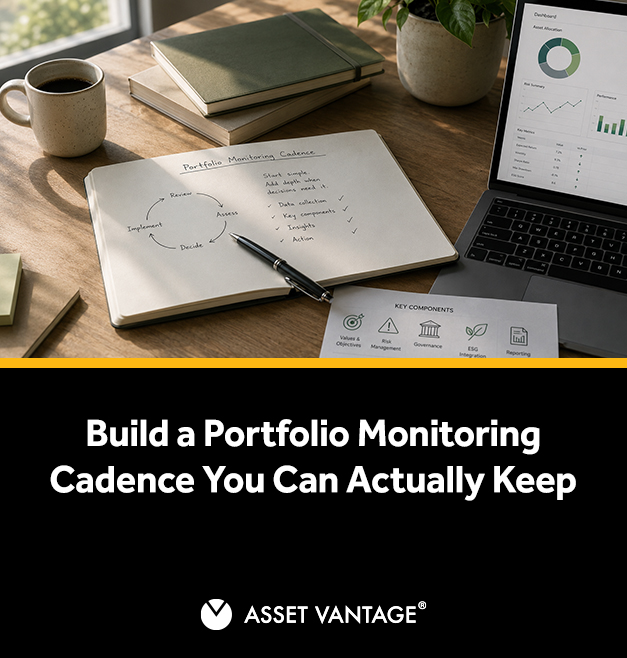
Decision-first monitoring only works when it becomes a repeatable operating rhythm. Start with a review cadence you can keep, run the same core monitoring loop each time, and add complexity only after the process reliably produces action.
Start With a Simple Review Rhythm, Then Earn More Depth
Most monitoring systems fail for a simple reason. The review rhythm asks for more effort than the team or investor can sustain. A modest cadence creates control because it is repeated, whereas an overbuilt one often leads to skipped reviews, stale notes, and decisions made without a current view.
A practical starting point is usually a light weekly check for exceptions, a deeper monthly review for changes that may require action, and a quarterly reset for bigger allocation, risk, or performance questions. The exact calendar matters less than consistency. If the cadence breaks under normal operating conditions, it is already too complex.
Earn more depth only when the current process is stable. Add another metric, another comparison, or another layer of reporting after the existing review rhythm is producing clear decisions on time. Structure should follow the decision need, not the urge to watch everything.
Use the Same Core Loop Every Time: Collect, Review, Decide, Act
The loop should stay fixed even when the audience changes. That consistency is what turns monitoring from occasional observation into a dependable process for the portfolio.
- Collect: Run a consistent data collection process before each review. Pull the portfolio data you actually need, confirm that the inputs are current, and avoid adding side metrics that do not support a decision. Clean collection matters because weak inputs distort everything that follows.
- Review: Read the information against the decisions the portfolio owner needs to make. Look for drift, concentration, liquidity pressure, performance gaps, missed targets, or changes in market conditions that affect interpretation. This step is where raw numbers become operating visibility.
- Decide: Turn observations into a small number of clear calls. Hold, rebalance, escalate, investigate, or wait are all valid outcomes if the reason is explicit. The purpose is data-driven decisions, not more commentary.
- Act: Assign the next step, the owner, and the timing. If no action, owner, or follow-up exists, the cycle was only observation. Monitoring changes in outcomes when the decision is closed into execution.
Keep the steps in that order. If review starts before the data collection process is complete, or if action starts before the decision is explicit, the core monitoring loop becomes noisy and inconsistent. The method is simple by design, so later sections can show how the same sequence deepens as complexity rises.
The Mistakes That Make Monitoring Collapse After a Few Weeks
Monitoring usually breaks because the process becomes either too heavy or too vague. The collapse rarely comes from one missed review. It comes from a design that requires too much manual effort, tracks too many inputs, or leaves no one responsible for what happens next.
- Too many metrics. Fix: Cut back to the few measures that can change a decision.
- Too much manual data entry. Fix: Reduce handwork until the cadence can survive a normal week.
- No clear review owner. Fix: Assign one person or team to run each cycle.
- No action threshold. Fix: Define what actually triggers a hold, rebalance, escalation, or follow-up.
- Irregular timing. Fix: Put the cadence on a calendar and treat it like an operating requirement, not a nice-to-have.
- More reporting than decision value. Fix: Remove any step that adds visibility without changing what the portfolio team does.
Once the loop holds under ordinary conditions, it can support more depth. That is the standard the audience-specific sections build on next.
How PE and VC Firms Monitor Portfolio Companies, Fund-Level Results, and Investor Reporting
The loop stays the same. In private capital markets, the depth of monitoring changes because it must support three decisions at once: what is happening inside portfolio companies, what that means for fund performance across private equity funds and their investments, and how fund managers translate that internal view into credible investor reporting. That structure matters because strong portfolio results do not automatically answer vehicle-level questions, and internal monitoring only becomes useful when the output can travel cleanly into external communication.
| Monitoring layer | Primary question | Typical output |
| Portfolio companies | What operating change needs attention now? | Intervention priorities and follow-up actions |
| Fund level | How is the portfolio affecting fund performance? | Vehicle-level performance judgment |
| Investor reporting | What do limited partners and other stakeholders need to see? | Structured updates, explanations, and next-step follow-up |
Portfolio-Company Metrics and Fund-Level Metrics Answer Different Questions
The first monitoring mistake in private equity is a category error. Portfolio company metrics tell investment teams how individual companies are operating: whether cash flows are tightening, whether key performance indicators are holding steady, and whether portfolio company data points to a fixable issue within the business. Fund-level metrics answer a different question. They show what the full portfolio of private companies is producing for the vehicle and its investors.
| Layer or metric | What it measures | Why it matters |
| Portfolio-company metrics | Operating signals such as cash flows, growth quality, and other key performance indicators inside individual companies | Used to judge how a company operates and whether intervention is needed |
| IRR | Money-weighted discount rate that sets the present value of contributions equal to the present value of distributions plus the remaining unrealized value | Fund-level performance metric, not a portfolio-company operating KPI |
| DPI | Cumulative distributions since inception / cumulative paid-in capital since inception | Shows realized cash returned to investors |
| TVPI | (Cumulative distributions + residual value) / cumulative paid-in capital since inception | Shows total value including unrealized holdings |
| TVPI relationship | TVPI = DPI + RVPI | Useful shorthand if mentioned |
Fund Performance and Financial Performance Need Separate Views
A healthy asset does not guarantee a healthy fund. Financial performance at the company level may show revenue strength, tighter margins, or improved execution, but fund performance depends on timing, realized distributions, unrealized value, and how the full set of private funds or portfolio positions moves together. A PE fund can hold strong businesses and still show weaker overall performance if exits are delayed or capital has not yet translated into distributions. That is why track record discussions need separate views: one for company-level operating strength and another for vehicle-level fund performance.
Due Diligence Does Not End After the Deal Closes
Post-close monitoring is due diligence in operating form. The investment thesis still has to survive real financial data, financial statements, management execution, and shifting conditions inside the business. In practice, investment teams use a recurring review loop to identify areas where value creation is slipping, where operational improvements are needed, whether value creation plans still hold, and where early identification can prevent a small issue from becoming a structural miss. The goal is not passive observation. It is post-close control.
- Watch cash runway, then intervene on hiring pace, spending, or the financing plan.
- Review customer retention and revenue quality, then run a deeper thesis check if the pattern weakens.
- Track hiring velocity and leadership gaps, then add talent support or reset growth expectations.
- Compare margin or burn rate variance against plan, then reprioritize value creation.
- Monitor working-capital pressure and collections issues, then push short-term operating follow-up with management.
Investor Reporting Turns Monitoring Into LP Communication and Follow-Up
Monitoring becomes external accountability when it moves into investor reporting. For U.S. funds, quarterly reports may be common in practice, but the actual reporting process and cadence usually follow the LPA and any side letters rather than one universal rule for institutional investors or limited partners. That boundary matters because timely data has to support both communication and governance. Form PF, for example, is regulatory reporting to the SEC, not LP communication. In AIFMD and FCA contexts, annual report requirements are separate again and follow their own timing rules.
- Package internal monitoring into clear updates on fund results, portfolio developments, and follow-up items for limited partners.
- Use timely data from the internal team to enhance transparency with institutional investors and other stakeholders.
- If the custody-rule audit pathway applies in the U.S., treat the 120-day timing, or 180 days for certain funds of funds, as a compliance route for audited financial statements rather than as a universal LP update schedule.
- Use the reporting process to streamline reporting discussions, document questions, and assign follow-up actions.
Advisor monitoring still needs discipline, but it does not carry the same layered split among portfolio-company intervention, fund-level judgment, and LP communication.
How Financial Advisors Monitor Client Portfolios Without Losing the Signal
Advisor monitoring is an exception-filtering job. While investment firms may monitor funds, reporting layers, and operating entities, an advisor usually needs to identify the smaller subset of household changes that actually warrant outreach or action.
A useful example starts with a household whose allocation has drifted from its target mix. The alert does not trigger an automatic trade. It triggers a review of the client’s IPS, followed by a check of taxes, transaction costs, cash needs, and current risk, before the advisor decides whether to rebalance, wait, or call the client. The point is not constant watching. The point is a client-specific action path tied to policy.
The Metrics That Matter More Than Account Watching
The highest-value advisor review does not start with activity screens or daily performance noise. It starts with the few signals that show whether the portfolio still fits the client’s plan, because performance analysis matters only when it changes suitability, timing, or follow-through.
- Allocation Drift Versus Target Policy: the clearest sign that portfolio risk may no longer match the agreed mix.
- Risk Exposure Relative to Client Tolerance: a stronger monitoring signal than simple account movement because it tests fit, not motion.
- Tax Position and Embedded Gains: a practical check on whether a rebalance is worth executing now or better deferred.
- Liquidity and Near-Term Cash Needs: a reminder that a sound allocation change can still be the wrong move if cash demands are close.
- Concentration or Mandate Exceptions: a useful flag when one holding, sector, or sleeve starts to dominate the portfolio’s behavior.
Benchmark Discipline, Drift Checks, and Risk Flags
Alerts need governance before they lead to trades or outreach. Benchmark discipline means the advisor tests the alert against the client’s stated policy and circumstances rather than against a blanket rule or a market headline.
- Confirm that the comparison point is the client’s benchmark and IPS, not a universal drift number.
- Verify that the drift check reflects the portfolio’s intended allocation, review cadence, and mandate.
- Reassess risk exposure in light of the client’s tolerance, time horizon, and current objectives before acting.
- Review taxes, transaction costs, and liquidity needs to see whether a technically correct rebalance is still the best move.
- Escalate only when the signal supports a real client action such as rebalancing, deferring with a reason, or contacting the household to revisit the plan.
When Custom Dashboards Improve Visibility and Review Discipline
Custom dashboards help only when they improve triage. A standard view is often enough if the advisor can already clearly see drift, cash demands, and unresolved follow-ups.
The case for customizable dashboards appears when the workflow itself becomes harder to control across many households, account types, or review schedules. In that setting, they can increase visibility by surfacing exceptions in the same order the team reviews them, turning the dashboard into a discipline tool rather than a screen-count upgrade.
The Advisor Tools and Key Features That Turn Monitoring Into Client Action
Advisor tools matter when they close the gap between noticing a signal and proving what happened next. The key features are those that connect an alert to a review record, a client note, and a documented decision, because these support ongoing oversight, suitability-related records, regulatory compliance with relevant laws, and clean follow-through under firm policy.
- Drift alerts are tied to client policy, so the team reviews exceptions rather than reviewing every account.
- Notes integration, so the reason for acting, waiting, or contacting the client stays attached to the case.
- Templated reviews, so recurring decisions follow the same client action workflow across households.
- Action tracking and audit trails, so the firm can show what was reviewed, who responded, and what decision was recorded.
For a self-directed investor, the same monitoring logic remains, but most of the multi-client workflow burden disappears.
How Individual Investors Monitor a Portfolio Without Overreacting
Personal monitoring should get clearer as the audience gets smaller. For an individual investor, the goal is not to watch every market move or maximize returns through constant activity. It is to run a repeatable review of the portfolio, notice drift, and act only when a preset rule or a real-life change calls for it. A sustainable routine usually looks less like a trading screen and more like a short monthly check with a deeper quarterly review.
Track a Small Set of Metrics You Will Actually Review
A crowded dashboard creates noise before it creates judgment. For personal performance tracking, a few recurring checks usually matter more than a long list of performance metrics that never get reviewed after the first week.
- Current allocation by holding or asset class, so the investor can see what the portfolio actually owns.
- Portfolio drift from the target mix, so review time stays tied to decisions rather than curiosity.
- Contribution progress and cash added, so new money is tracked alongside market movement.
- Recent performance over a consistent period, so changes are read in context instead of from a single day.
- Record the reason for any trade or rebalance, so each change has a visible decision trail.
Use Market Conditions as Context, Not as a Reason to Constantly Tinker
Volatility does not automatically require action. Market conditions matter when they trigger a rule the investor has already set, such as a rebalance band, a cash need, or a change in risk tolerance.
- If prices move but the allocation still sits within the chosen range, note it and move on.
- If market conditions push the portfolio outside that range, review the trade against the original plan before acting.
- If the real change is personal rather than market-driven, update the plan first, then adjust the holdings.
The Key Features a Simple Spreadsheet or Dashboard Needs to Support Better Decisions
The smallest useful system is one that helps the investor review the entire portfolio consistently every time. For a simple spreadsheet or dashboard, the key features should support visibility, drift checks, and recorded decisions rather than add more tabs, charts, or commentary.
- A current holdings view that shows position size and total portfolio weight.
- A target allocation field next to the current allocation, so drift is visible at a glance.
- A simple review log with date, decision, and reason, so changes are tied to a rule.
- Basic performance history by period, so short-term moves do not dominate the review.
- A notes field for watch items, so the next review starts from the last real decision.
The Core Monitoring Loop Stays the Same, but the Depth Changes by Audience
The loop does not change across audiences. What changes is the amount of data, the reporting burden, and the number of people who depend on the review.
| Audience | What the loop reviews | Why the depth increases |
| Individual investor | Allocation, drift, contributions, and decision notes | One person needs a clear routine that is easy to sustain. |
| Financial advisor | Client drift, risk flags, benchmarks, and follow-up actions | Multiple households and service accountability require more structure. |
| PE or VC firm | Portfolio-company data, fund results, and investor reporting | Operating oversight and LP communication raise the monitoring burden. |
That difference sets up the final decision: choose the smallest monitoring system that still supports better decisions.
Choose the Smallest Monitoring System That Still Supports Better Decisions
Tooling should change execution before it expands data. The right portfolio monitoring setup makes the next review easier to run, keeps the portfolio visible in one place, and supports more informed decisions when action cannot wait. There is no universal upgrade number for portfolio monitoring tools. The better rule is operational strain: stay simple until manual consolidation, delayed follow-up, or fragmented visibility begins to weaken decision quality. The next comparisons show what that threshold looks like in practice: first by feature fit, then by the signals that justify moving beyond a spreadsheet.
What Good Tooling Changes Before It Adds More Data
More data is rarely the first problem. Monitoring usually breaks when the review loop becomes harder to run, signals arrive late, and action notes get lost.
Good tooling fixes that operating problem first. It should turn raw inputs into actionable insights, keep decisions tied to follow-up, and streamline operations around a single repeatable review sequence rather than scattered files.
That is why there is no clean numeric threshold for upgrading. Real-time insights matter only when the current process cannot surface exceptions fast enough. The issue is not more data. It is whether the system improves action discipline.
Which Key Features Best Match Your Audience and Monitoring Complexity
Feature fit should follow monitoring complexity, not software ambition. The useful key features are the ones that reduce review friction for a specific audience while preserving a system small enough to use consistently.
| Audience and complexity | Usually enough | Add next when | Useful features |
| Individual investor, low complexity | Spreadsheet | Review consistency needs a cleaner single view | Basic data refresh, drift flag, action notes |
| Advisor, moderate complexity | Spreadsheet or simple dashboard | Exception tracking and client follow-up become harder to manage manually | Alerts, household aggregation, templated reviews, notes, and workflow |
| PE or VC firm, or multi-entity team, high complexity | Dashboard | Multi-entity consolidation and reporting start slowing down decisions | Centralized aggregation, reporting, audit trail, role-based views |
When a Spreadsheet Is Enough, and When You Need a Real Dashboard
A spreadsheet is enough as long as the review stays timely, follow-through stays clean, and coordination remains light. A dashboard becomes justified when data handling, alerting, or shared visibility no longer scales cleanly.
| Signal | A spreadsheet is still enough | Dashboard becomes justified |
| Data handling | One or a few sources with low manual friction | Frequent manual consolidation across sources or entities |
| Decision speed | Review timing still supports action | Decisions lag because updates arrive too late |
| Alerts | Manual review still catches what matters | Automated alerts are needed to surface exceptions quickly |
| Collaboration | One owner or light collaboration | Multiple stakeholders need shared visibility and follow-up |
| Technical limits | You remain comfortably below product constraints | Product or collaboration limits are becoming operational blockers |


