Read Time4 Mins
The operations of a family office are multifaceted, requiring tools that are powerful, secure, and efficient. While many turn to spreadsheets for their simplicity and availability, spreadsheets are often too simplistic and fall short of meeting the comprehensive needs of modern family offices. Integrated systems, on the other hand, offer a superior solution by providing a unified platform that ensures data accuracy, confidentiality, and efficiency.
In this guide, we explore why integrated systems are the ultimate choice for family offices, comparing their capabilities with those of spreadsheets across key operational aspects.
Privacy and User Permissions
Confidentiality and access control are critical for family office operations. Integrated systems excel in this area by offering sophisticated access control mechanisms. They allow for the precise slicing of data across different users and permissions, ensuring that sensitive information is accessible only by authorized personnel. This level of control is crucial for maintaining privacy and complying with data protection regulations.
On the other hand, while spreadsheets are versatile, they lack the depth of security features required for sensitive financial data. Implementing audit trails and tracking changes in spreadsheets is cumbersome and prone to errors, making it nearly impossible to maintain a reliable record.
Also Read: Data Security & Privacy in Family Office Software: What You Need to Know
Single Source of Truth
Family offices often manage diverse and complex financial portfolios with liquid as well as illiquid assets, which are in turn held through complicated ownership structures. They also need to keep a track of various other aspects such as liquidity, cash flow, exchange rates, tax laws, and investment-related expenses. However, this information is scattered across multiple systems. The process of compiling all this data to make insight-driven decisions tends to be inefficient and leaves much room for errors.
Integrated systems solve this issue by automatically pulling information from the varied sources and consolidating all financial data onto a single, unified platform. They become the single source of truth and ensure that all stakeholders have access to accurate, up-to-date information.
With spreadsheets, consolidation and reconciliation of financial information is a manual, time-consuming, and cumbersome task. There are more chances of data getting left behind, keeping crucial insights for greater family office success hidden from view.
Automated and Accurate Data Entry
The recording of transactions across various brokers, funds, and entities is a significant challenge in family office management. The complexity and sheer volume of financial transactions can overwhelm spreadsheet-based systems, leading to data inaccuracies and inefficiencies. Manually entering information into spreadsheets is not only time-consuming but also highly prone to mistakes.
Integrated systems, with their automation capabilities, provide a reliable solution that enhances accuracy and efficiency. They pull data from various sources such as custodian feeds to automatically record transactions and generate family office books of accounts, which becomes the base for financial reporting and analysis.
Investment Returns and Comparison Over Time
Analyzing the performance of different investment strategies or advisory relationships requires the ability to compare portfolios over multiple periods with precise benchmarking. Integrated systems are designed to handle such complex comparisons, providing family offices with the tools to conduct thorough historical analysis and performance evaluations.
Spreadsheets lack the functionality to perform these sophisticated analyses. The manual effort required to input and analyze data increases the likelihood of errors and inconsistencies, undermining the reliability of the results. Integrated systems streamline this process, offering comprehensive insights that drive informed investment decisions.
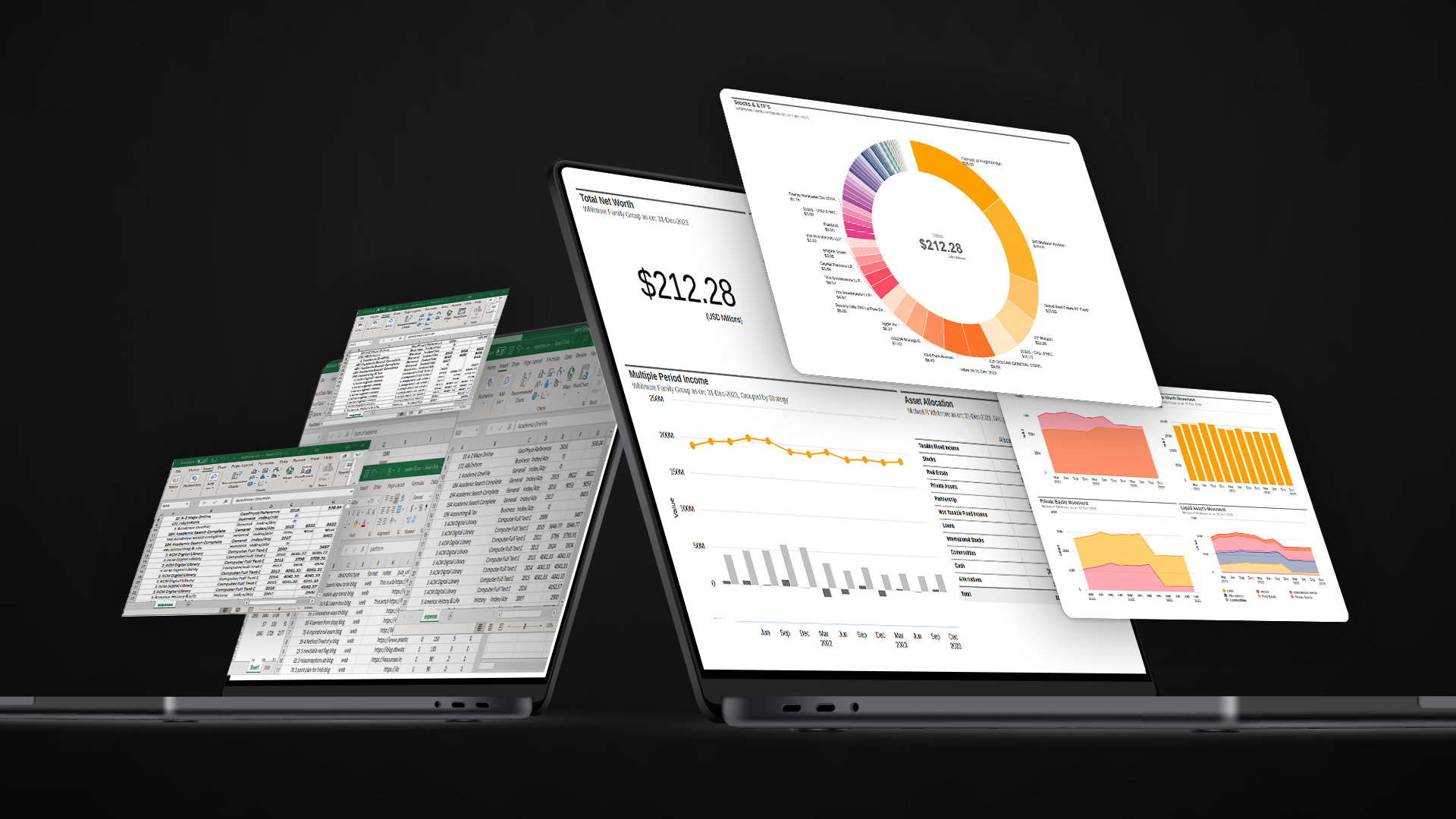
Enterprise-Grade Platform for Family Offices
Ultimately, to manage your wealth as you would your business, you need an enterprise-grade platform. Trusting only spreadsheets to run your business instead of an ERP is unthinkable, and the same applies to managing family office operations.
Integrated systems, including specialized Family Office Software such as Asset Vantage, provide the security, efficiency, and accuracy required to manage complex family wealth effectively, ensuring that your financial management is as robust and reliable as your business operations.
Asset Vantage’s integrated performance reporting and general ledger technology provides a cutting-edge solution for global and modern family offices. This platform streamlines processes, eliminates the high manual effort and cost associated with separate systems, and fuels growth by providing a cohesive and reliable tool for all financial activities.
Investing in an integrated system is not just a technological upgrade; it’s a strategic move toward better investment decisions, risk management, governance, and process efficiencies. For family offices aiming to maintain a competitive edge and ensure the longevity of their financial legacy, integrated systems are the clear choice.